Advice
Artificial Grass vs Real Grass in Ireland
TL;DR
Artificial grass suits shady gardens, dog runs, small courtyards, and low-maintenance lets, costing from €65/m² installed with almost no upkeep. A real lawn is cheaper to lay from €18/m², cooler, better for wildlife, and ideal for big sunny gardens, but it needs mowing and care. The right choice depends on the spot.
The quick answer
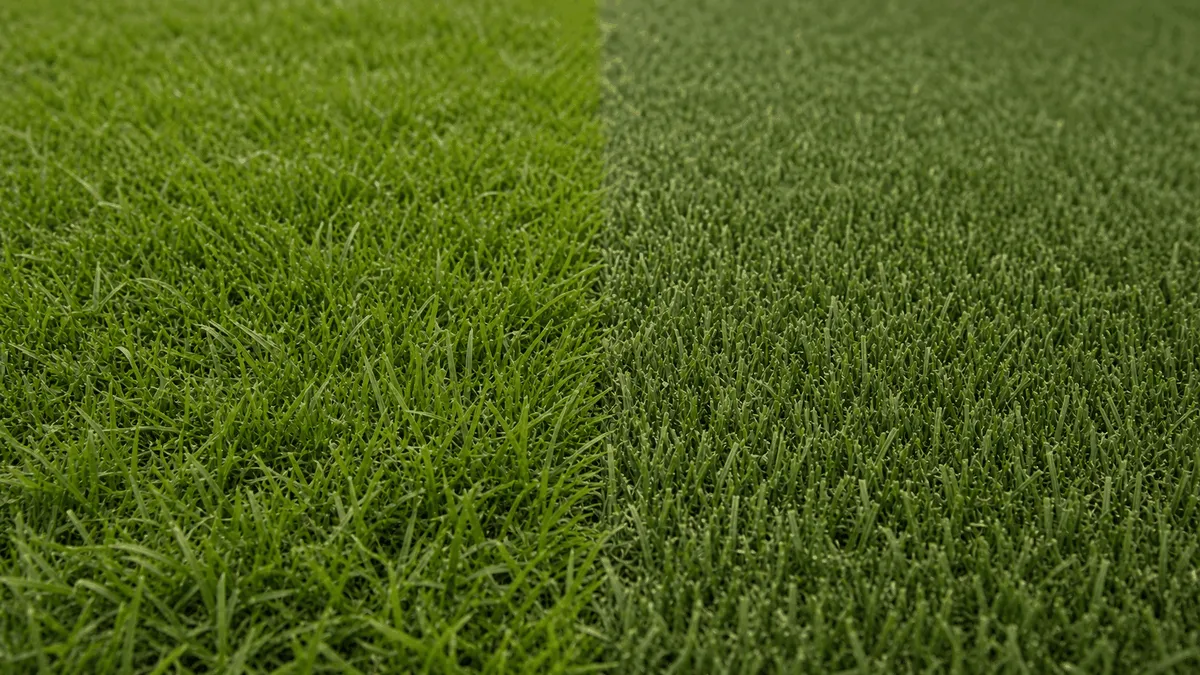
There is no single winner. Artificial grass wins for deep shade, heavy dog use, small courtyards, and rental properties that must look perfect with no upkeep. A real lawn wins for large, sunny family gardens, for wildlife, and on cost.
The honest test is the spot itself. We tell clients straight when a real lawn would serve them better, and when artificial is the sensible call.
Cost compared
A real lawn is cheaper to install, from around €18/m² for roll turf with soil preparation. Artificial grass costs more up front, from €65/m² installed, because of the stone sub-base it needs.
Over time the gap narrows. A real lawn carries ongoing costs in mowing, feeding, and your time, while quality artificial grass needs only an occasional brush and rinse. Cheap artificial grass is a false economy, as it flattens and fades within a few years.
Maintenance
This is where artificial grass earns its keep. No mowing, no feeding, no scarifying, no muddy patches, and it looks the same in February as in July. A rinse and a brush a few times a year is all it asks.
A real lawn needs regular mowing through the growing season, feeding, the odd bit of reseeding, and patience after wet spells. For some that is a pleasure, for others a chore they would happily lose.
Drainage and the Irish climate
In Ireland's rainfall, drainage decides everything. A real lawn on heavy clay can sit waterlogged for months unless the ground is improved or drained. Quality artificial grass on a compacted stone sub-base drains straight through and stays usable.
Poorly installed artificial grass laid on soil is the worst of both worlds, pooling and rippling. The base is what makes or breaks it, which is why we never lay grass straight onto the ground.
Pets and kids
For dogs, artificial grass on a free-draining base is hard to beat, as it does not churn into mud and a rinse keeps it fresh. For children, it gives a clean, dry, year-round play surface, though it can warm up in direct summer sun.
A real lawn is cooler underfoot and softer for tumbles, but takes a beating from paws and football and needs recovery time.
Environment and wildlife
A real lawn, especially one left a little wild, supports insects, birds, and soil life, and helps rainwater soak away. It is the better choice for biodiversity, which the All-Ireland Pollinator Plan encourages.
Artificial grass uses no water, fertiliser, or pesticides once down, but it is a plastic product that supports no wildlife and must eventually be replaced. Weigh that against the practical benefits for your situation.
Which should you choose?
As a quick guide:
- Choose artificial for deep shade, dog runs, small courtyards, and low-maintenance lets
- Choose a real lawn for large sunny gardens, wildlife, and the lowest install cost
- Whatever you choose, the preparation underneath is what makes it last
Would you rather we just did it?
Our artificial grass service, on a fixed price.
Advice
Frequently asked questions
Is artificial grass worth it in Ireland?
For the right spot, yes. Artificial grass is worth it for shady gardens, dog runs, small courtyards, and rentals that must look perfect with no upkeep, costing from €65/m² installed. For a large sunny garden, a real lawn is cheaper, cooler, and better for wildlife. It comes down to the specific space.
Does artificial grass get hot in summer?
It can warm up in direct summer sun, more than a real lawn, though Ireland's climate means that is rarely an issue for long. In a garden that bakes all afternoon, a lighter-coloured grass and some shade planting help. For most Irish gardens it is a minor consideration.
How long does artificial grass last?
Quality 40mm artificial grass lasts 15 years or more and often longer with light care, and the stone base lasts indefinitely. Cheap grass flattens and fades within a few years, which is why the product quality and the base matter as much as the install.
Is artificial grass bad for the environment?
It is a mixed picture. Artificial grass uses no water, fertiliser, or pesticides once installed, but it is a plastic product that supports no wildlife and must eventually be replaced. A real lawn, especially a slightly wild one, is far better for biodiversity and drainage.
Can you lay artificial grass over an existing lawn?
We do not recommend laying it straight over soil or an old lawn, as it ripples, pools water, and fails. Proper installation means excavating, laying a compacted stone sub-base, and fixing edging, which is what lets it drain and last. The base is the whole job.
Keep reading